
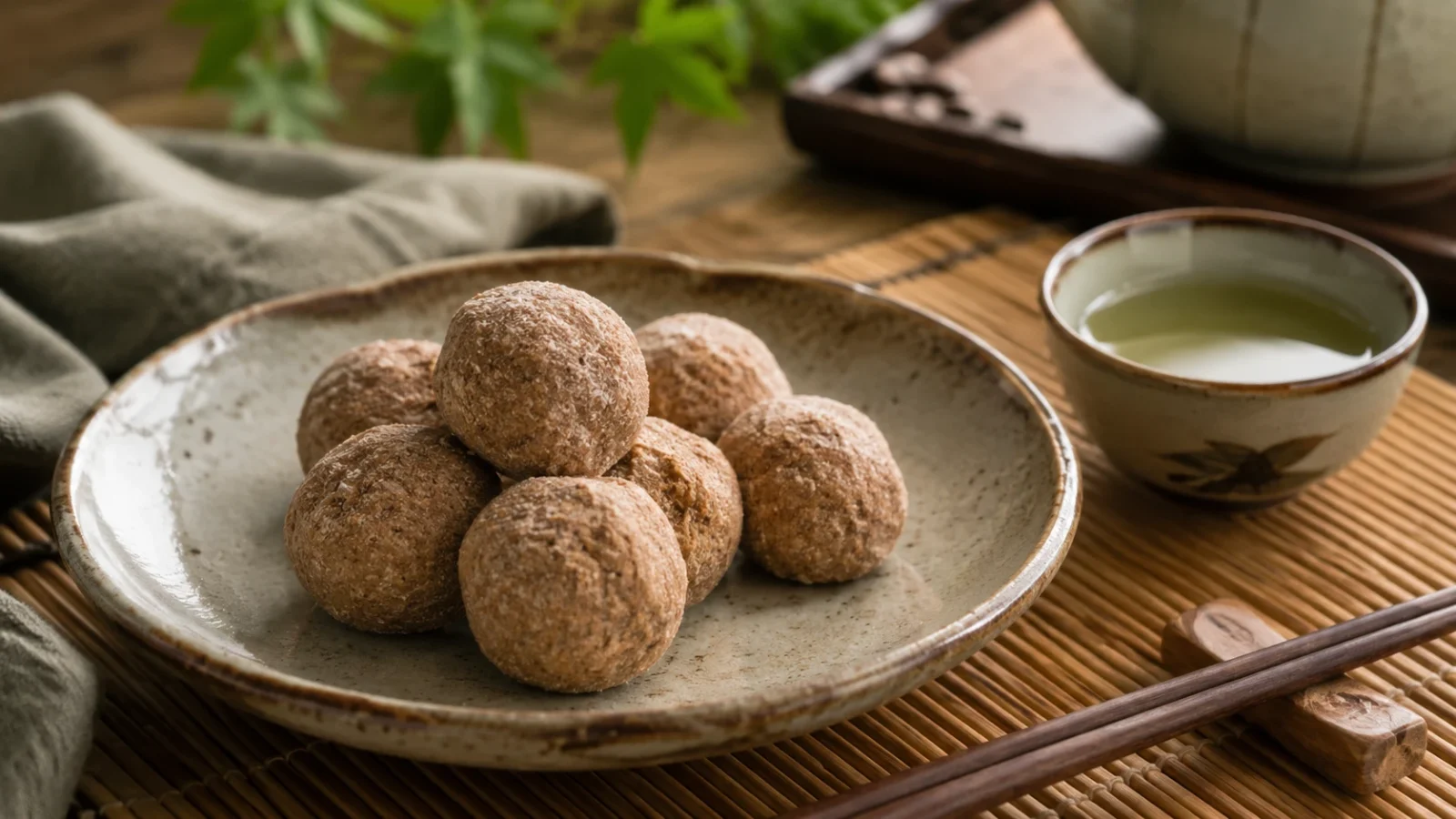
Long before gym bags contained protein bars with names like “Thunder Beast Max Fuel”, Japan had something far more mysterious, compact and frankly cooler: hyōrōgan. Also known as “provision balls”, these small, dense ration snacks are commonly associated with ninja, or shinobi, who supposedly carried them on long missions when a proper meal was about as convenient as announcing your hiding place with a trumpet solo.
Hyōrōgan were designed for practicality. They were portable, energy-dense and made from ingredients that could be carried, stored and eaten without the need for a kitchen. In historical recipes and modern reconstructions, they often include some combination of rice flour, lotus seed, coix seed, yam, cinnamon, sugar and ginseng. That makes them less like a modern dessert and more like a cross between a survival ration, a medicinal sweet and a granola ball that has taken up martial arts.
The word itself points to function. “Hyōrō” relates to provisions or military rations, while “gan” can mean a pill or ball. In other words, these were not meant to be dainty tea-room confections. They were compact fuel. For warriors, scouts, messengers and covert operatives, a few small balls tucked into a pouch could provide quick energy and a sense of preparedness. Whether every shadowy figure in black was nibbling them before scaling castle walls is another question, but the idea has become irresistible. History rarely gives us snack food with such excellent branding.
The romantic image of the ninja can be a bit overcooked today. Popular culture has given us smoke bombs, roof leaping, impossible stealth and, thanks to a certain cartoon turtle franchise, an unreasonable amount of pizza. Real shinobi, however, were more likely to be concerned with patience, disguise, intelligence gathering, endurance and not getting caught. A food like hyōrōgan fits that world beautifully. It is humble, clever and unglamorous in exactly the way useful things often are.
Today, hyōrōgan is enjoyed less as battlefield food and more as a historical curiosity, cultural snack and conversation starter. It appears in ninja-themed tourism, historical food videos, martial arts circles and experimental kitchens. Some modern versions lean sweet and cinnamony, while others try to stay closer to older ingredient lists. The result can taste surprisingly pleasant, though it will not fool anyone into thinking it is a cupcake. It is earthy, aromatic, slightly chewy and powerfully old-fashioned. Eat one and you may not become invisible, but you will feel like you packed more efficiently than everyone else.
What Does Hyōrōgan Taste Like?
A good hyōrōgan should be sweet, spiced and dense, with a grainy nuttiness from rice and seeds. Cinnamon gives it warmth, lotus seed adds body, and yam helps bind the mixture. If ginseng is used, it can bring a faintly bitter, herbal edge. Think of it as a historical energy bite with a medicinal wink.
The texture depends on how finely you grind the ingredients and how much moisture you use. A smoother grind produces a more cohesive ball. A rougher grind gives a rustic bite, which feels satisfyingly authentic, even if your “mission” is mostly answering emails and trying not to buy more houseplants.
Homemade Hyōrōgan Recipe
This version is inspired by historical recipes, but adapted for a modern home kitchen. It makes a small batch rather than enough rations for a travelling band of suspiciously quiet mountain operatives.
Yield
Makes approximately 18 to 24 small provision balls.
Ingredients
- 1/2 cup glutinous rice flour
- 1/2 cup regular rice flour
- 2 tablespoons lotus seeds, dried
- 1 tablespoon coix seeds, also sold as Job’s tears or adlay
- 1 tablespoon finely grated Japanese yam, Chinese yam or nagaimo
- 1/2 cup raw sugar or finely chopped crystallised sugar
- 1 teaspoon ground cinnamon
- 1/8 teaspoon powdered Asian ginseng, optional
- 3 to 5 tablespoons hot water, added gradually
- Extra rice flour, for dusting your hands
Ingredient Notes
Lotus seeds and coix seeds are often available from Asian grocery stores, Chinese herbal shops or online suppliers. If you cannot find lotus seeds, you can use cooked chestnut or a small amount of almond meal as a modern substitute, though the flavour will be different.
Ginseng is optional. It appears in some traditional-style recipes, but it has a strong flavour and may interact with some medications. Leave it out if you are pregnant, preparing these for children, sensitive to stimulants or simply not in the mood for your snack to taste like it studied herbal medicine.
Japanese yam or nagaimo can feel slippery when grated. This is normal. It helps bind the mixture and gives the balls a slightly chewy texture. If you cannot find it, use a teaspoon of honey or rice syrup as a practical modern binder.
Step-by-Step Instructions
1. Prepare the lotus and coix seeds
Place the dried lotus seeds and coix seeds in a spice grinder, high-powered blender or mortar and pestle. Grind them as finely as possible. You are aiming for a coarse flour rather than large crunchy chunks. If your grinder struggles, pulse in short bursts and let the motor rest between rounds.
2. Mix the dry ingredients
In a medium mixing bowl, combine the glutinous rice flour, regular rice flour, ground lotus seeds, ground coix seeds, sugar, cinnamon and optional ginseng. Stir thoroughly so the cinnamon and ginseng are evenly distributed. This is important because nobody wants one heroic bite of pure ginseng ambush.
3. Add the grated yam
Stir in the finely grated yam. The mixture may clump slightly, which is a good sign. Use your fingers or a spoon to rub the yam through the dry ingredients until the texture resembles damp sand.
4. Add hot water gradually
Add hot water one tablespoon at a time, mixing well after each addition. Stop when the mixture forms a stiff, slightly sticky dough. It should hold together when pressed, but should not be wet or runny. If it becomes too soft, add a little more rice flour.
5. Steam the mixture
Line a bamboo steamer or metal steamer basket with baking paper. Spread the dough into a rough, even layer. Steam over simmering water for 10 to 12 minutes. This helps hydrate the flours and bind the mixture.
6. Cool just enough to handle
Transfer the steamed mixture to a bowl and let it cool for a few minutes. Do not let it cool completely before shaping, as it becomes harder to roll once firm. It should be warm, not finger-scorching. Ninjas were tough, but they were not foolish.
7. Roll into balls
Lightly dust your hands with rice flour. Pinch off small portions and roll them into balls about 2 to 3 centimetres wide. For a more traditional ration-style version, make them smaller, closer to large marbles. For a modern snack version, walnut-sized balls are easier to serve.
8. Dry or store
Place the finished balls on a tray lined with baking paper. Let them air-dry for a few hours, turning occasionally. For a firmer texture, leave them uncovered in the fridge overnight. Store in an airtight container in the refrigerator for up to one week.
9. Serve thoughtfully
Enjoy one or two with tea, especially green tea or roasted hojicha. They also pair nicely with black coffee if you enjoy the contrast between sweet, spiced grain and bitterness. They are dense, so start small. This is a snack with the confidence of a brick.
Modern Serving Ideas
For a historically inspired tasting plate, serve hyōrōgan alongside roasted soybeans, dried persimmon, rice crackers and green tea. For a more playful approach, make them for a Japanese history night, martial arts gathering, anime marathon or ninja-themed party. They are also perfect for anyone who likes unusual recipes with a good story attached.
You can also adapt the flavour gently. A little toasted sesame adds nuttiness. A touch of kinako, roasted soybean flour, gives a warm and comforting flavour. A small amount of honey can make the texture softer and more approachable. Just remember that the charm of hyōrōgan lies in its simplicity. Add chocolate chips and you have wandered out of the mountains and into lunchbox territory.
A Small Snack With a Long Shadow
Hyōrōgan is fascinating because it sits at the meeting point of food, folklore, survival and imagination. It reminds us that cuisine is not only about pleasure. Sometimes food is about endurance, portability, secrecy and solving practical problems under pressure. That may not sound glamorous, but it is deeply human.
These little provision balls also reveal something charming about history. The past was not made only of battles, rulers and dramatic speeches. It was also made of small, useful things tucked into sleeves, pouches and travel bags. Hyōrōgan may not turn you into a rooftop shadow or help you vanish in a puff of smoke, but it does offer a taste of ingenuity. In one small bite, you get a reminder that good food does not always need to be luxurious. Sometimes, it just needs to be clever enough to survive the mission.